

Articles

An Entirely New Way of Converting Data

May 19, 2023
Caitlyn Truong

Data conversions are far too manual

Companies have moved their data from old to new since the first computer system was retired. Enterprise software has advanced a lot since then, but the process for converting data hasn’t. IT teams and consultants still rely on essential tools like spreadsheets, scripts, and SQL queries. These are labor-intensive and require high-level expertise, extending the timeline for onboarding new applications. This fragmented approach to data conversion is time-consuming and inefficient, resulting in too many projects delivered late and over budget.
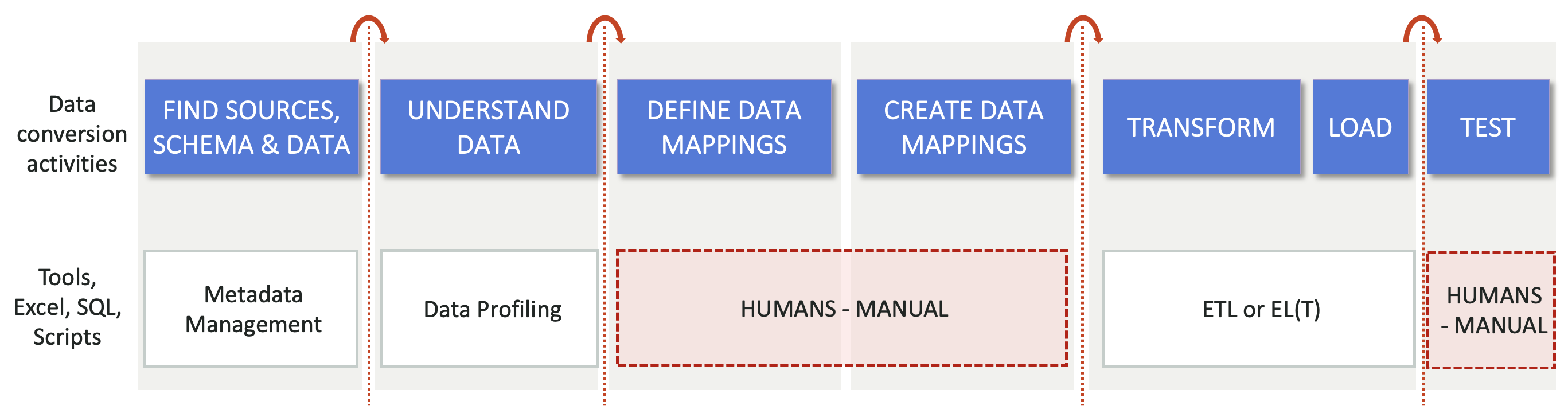
Zengines has a better way of converting data with a platform that automates the entire process from end to end. With Zengines, data conversion efforts are faster and less labor-intensive resulting in reduced costs and risk.
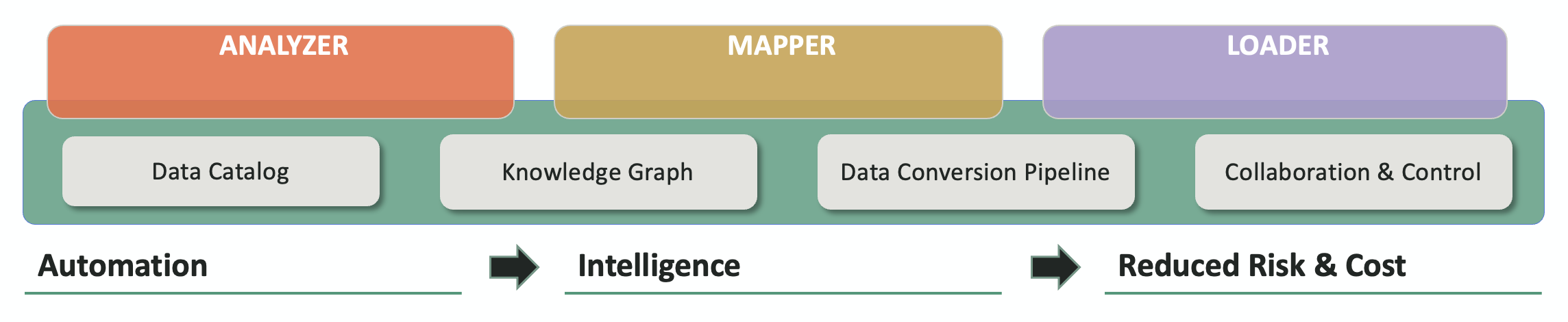
AI-powered data conversion rapidly accelerates data analysis, mapping, and testing

Companies migrating to new systems often need more expertise in the new target system. In contrast, software vendors for the new system tend to shift the responsibility for data conversion onto the data owners. This creates a data conversion gap that is challenging to navigate. Questions that customers of new software often ask include:

·       How long will it take to convert the data?

·       Will there be a gap in the data compatibility and completeness between the two systems?

·       Is my source data sufficient to populate the target system

·       Will I be able to achieve the business goals we are seeking?

·       Do I need to enrich my data from other sources?

·       Can my target store all of my current data?

With Zengines, a data conversion project never starts from scratch. Our AI algorithms understand the requirements of the target system. They will automatically analyze the source system's table structures, relationships, and data to automate the data conversion process. The result is a tremendous head start with any data conversion projects and a better understanding of what is required to achieve your business objectives.

How Zengines uses artificial intelligence to accelerate data conversions

  1. Analyzer: Connect to 45 different databases or ingest multi-format data sets from CSV, Excel, XML, PDF, or APIs
  2. Analyzer: Classify tables and fields. Automatically build relationships based on primary-key/foreign-key relationships.
  3. Analyzer: Identify quality issues within source data.
  4. Mapper: Identify source-to-target field matching.
  5. Mapper: Detect and resolve data type differences.
  6. Mapper: Produce field-level logic where data needs to be transformed to meet the requirements of the new target system.
  7. Loader: Integrated Testing and Validation

Zengines ML models continually improve with each new conversion, offering better results with each data conversion project.

Automating the data conversion process with the Zengines platform

Zengines provides an end-to-end platform, digitizing and streamlining each step of the data conversion process. This integrated approach simplifies the user experience, with inputs and outputs for each step in the process, and they seamlessly flow from step to step until all data is converted. Four technologies underpin the flow of data throughout the process:

  1. Zengines Data CatalogTM System migration projects need up-to-date, accurate metadata to identify critical patterns between the source and target systems. Zengines’ intelligent data catalog is rapidly constructed from all source and target system schemas and metadata generated by Zengines Analyzer, providing the foundation for data conversion analysis.
  2. Zengines Knowledge GraphTM The Zengines Knowledge Graph is the repository for training our powerful data conversion models. Our patent-pending technology uniquely builds domain-specific models for each industry and commercial software platform we have worked with. Customers benefit from prior data conversion efforts, making the algorithms smarter over time.
  3. Data Conversion Pipeline – On the Zengines platform, data flows through an integrated process: ingestion à cleansing à transformation à post-processing à loading of data, à reconciliation. Our Data Conversion Pipeline controls the flow of this data as it is prepared for the target system and enables rapid iterative cycles through the pipeline to refine outputs continuously.
  4. Collaboration and Control – System migration efforts involve many teams, people, and environments, such as Development, Testing, User Acceptance Testing, and Production. Hundreds or even thousands of decisions need to be made and tracked during these projects. Zengines Collaboration and Control module ensures that project users and resources stay organized and can operate from a common source of truth.

Why we load data fast, early and often

Companies migrating to new systems often need more expertise in the target system, while vendors tend to shift the data conversion responsibility onto the data owners. This creates a data gap that is challenging to navigate. To address this issue, it's crucial to adopt a target system-focused approach, starting with the new system's requirements in mind.

Target and downstream system vendors, product owners, and users eagerly wait to see their data within the new system resulting in project delays and waste. Zengines believes in loading data quickly, even if it's not initially perfect, to allow for iterative improvements in data completeness and quality and to drive overall project efficiencies.

Conclusion

Zengines offers an entirely new way of converting data. With an emphasis on speed and repeatability, Zengines combines artificial intelligence and automation to transform manual and time-consuming data conversions into an efficient and predictable process.

You may also like

In 2006, British mathematician Clive Humby coined a phrase that would define the next two decades of enterprise thinking: "data is the new oil." A decade later, in May 2017, The Economist made it a cover story – declaring data the world's most valuable resource and arguing that the data economy demanded a new approach to competition itself.

Twenty years after Humby first said it, the metaphor has only become more apt. What's changed is the catalyst. AI – and specifically the broad accessibility of large language models – has turned the abstract value of data into something organizations can now act on, at scale, in their actual operations. Every enterprise executive and Board member conversation I'm in today centers on the same question: are we positioned to scale value from AI?

The honest answer for most financial services enterprises is: not yet. And the gap isn't model selection, infrastructure, or use case prioritization. The gap is data readiness.

This post lays out what "AI-ready data" actually means in an enterprise context and the two capabilities that determine whether you have it.

What "AI-Ready Data" Actually Means

Strip away the hype, and AI-ready data comes down to two things:

  1. The data has to be available – meaning it can be moved, accessed, and used by modern systems regardless of where it originally lived.
  2. The data has to be trustworthy – meaning you know and can explain what it is, where it came from, and what business logic shaped it.

Both sound obvious. Neither is easy. And in older institutions with legacy applications – like in financial services – where institutions are sitting on decades of data stored across generations of systems, both require deliberate enterprise capability.

Pillar 1: Data Usability

Decades of preserved data only retains its value if the organization can keep it working. That means the ability to move it, transform it, and deliver it in a form whatever comes next can ingest; a new platform, a new analytics layer, an AI tool. Without that organizational capability, preserved data becomes stranded data.

Making data persistently usable across system changes is a data migration problem.

For institutions that have spent decades preserving customer records, transaction histories, account positions, and policy data, that preservation only translates into value if the data remains usable today. Not in the form it was stored in 30 years ago. In the form your current systems, your current analysts, and your current AI tools can ingest.

That's where data migration comes in – and where I'd encourage every executive to reframe how they think about it.

For most of the last 20 years, data migration has been treated as a one-time, project-bound activity tied to a specific systems initiative. A core conversion. A CRM rollout. An acquisition. A means to an end – the job had a start date and an end date, and once the data was "moved," the team and tools were disbanded.

That framing made sense in a world where systems changed every 10 to 15 years. It doesn't make sense anymore. The pace of modernization – driven by cloud adoption, AI tooling, vendor consolidation, and M&A – means data is constantly in motion. Treating each move as a bespoke, manually-staffed project is what makes modernization slow, expensive, and risky.

We built Zengines' data migration platform on a different premise: that data migration is a change capability, not a one-time activity. It's how you ensure your data remains an asset across every system change you'll make in the next 20 years – regardless of source format, target schema, or technology stack. That's what makes the underlying asset AI-ready: portable, repeatable, accessible.

For ISVs, BPOs, and MSPs onboarding clients onto modern platforms, the same logic applies and the economics are even more direct. Data conversion is, as I've argued before, a CEO-level concern – every client conversion that takes six months instead of six weeks is revenue deferred. Our platform compresses onboarding timelines by up to 80% by automating the manual work of mapping, profiling, transforming, and moving.

Pillar 2: Data Trustworthiness

Trustworthiness has many dimensions; data quality, governance, compliance controls. But none of those can be properly established without first answering a more fundamental question: what does this data actually represent, what logic produced it, where did it come from, and why does it look the way it does? That's a lineage problem, and it has to be solved before the rest can follow. In legacy-heavy environments, it's even harder to answer.

Trustworthiness matters on two distinct fronts:

First, the consumers of AI outputs; analysts, risk managers, portfolio teams; will act on what they trust. AI outputs will certainly attract interest; but that confidence erodes the moment someone is in a hot seat and can't explain a result, defend a decision, or reconcile an inconsistency. Without traceable source logic, that moment is a matter of when, not if.

Second, regulators are already examining AI model inputs. Under regulatory frameworks like BCBS 239, ORSA, Solvency II, "we trained on legacy system output" is not an explanation. The explanation lives in the code.

This is where data lineage matters, and where financial services has a particular challenge.

A significant portion of the data that drives banking, insurance, and asset management still flows through legacy systems – mainframes and the codebases that sit on them: COBOL, RPG, PL/1, Assembler. These systems weren't built to expose their logic to outside observers. The data they produce reflects calculations, conditional branches, and business rules that were written decades ago, often by people who have long since retired. When a CDO asks today, why does our risk exposure calculation produce this number?, the answer is buried in code that no current analyst can quickly read end-to-end.

At one Fortune 100 financial institution we work with, the environment includes nearly 100,000 COBOL modules. That's not unusual for an enterprise of that scale. It's the norm.

Without a way to expose the logic embedded in those systems, AI initiatives that touch this data are flying blind. You can train a model on the outputs, but you can't explain the outputs. You can move the data, but you can't verify what it represents. For regulated institutions, that's a non-starter.

This is the problem Zengines' Contextual Data Lineage solves. It parses legacy code – COBOL, RPG, PL/1 – and surfaces the business logic embedded inside: calculations, branching conditions, data origins, downstream dependencies. Instead of waiting nine months for a subject matter expert to reverse-engineer a single business rule, an analyst can answer the question in minutes. That's what makes legacy data not just movable, but explainable. And explainability is what makes data AI-ready in a regulated environment.

Why This Matters Now

The institutions making the most progress on AI right now aren't the ones with the most ambitious model strategies. They're the ones who've done the unglamorous work on the foundation – ensuring their data is preserved across system changes, and that the logic embedded in their legacy systems is documented, understandable, and ready to be replicated or retired with confidence.

That foundation is what allows AI initiatives to move from pilot to production to scaled value. It's what allows risk teams to validate AI-driven outputs against regulatory expectations  with confidence. It's what allows finance and operations teams to actually trust what AI is telling them.

The window to build this foundation is now. Every quarter spent treating data migration as a project – or treating legacy code as an unsolvable black box – is a quarter of AI value deferred.

Two Capabilities, One Outcome

AI-ready data isn't a destination. It's the natural outcome of two capabilities working together: the ability to move data through any transformation or modernization without losing it, and the ability to understand the logic that defines what the data means over time and pathways.

Zengines was built to deliver both. Our data migration platform makes data preservation and utility a repeatable, AI-accelerated capability. Our Contextual Data Lineage exposes the logic locked inside legacy systems so analysts, auditors, and AI tools can use it with confidence.

If your organization is wrestling with how to position your data for AI – whether that's preserving decades of records through modernization, or making your legacy systems explainable to your CDO, CRO, or your regulators – we should talk.

See how Zengines accelerates the path to AI-ready data.

BOSTON, MA - May 8, 2026 - Zengines, Inc. today announced it has won Best of Show at FinovateSpring 2026, selected by audience and judges vote at the premier fintech demo event. The conference brought together more than 1,200 senior-level fintech and financial services executives - including 600+ from banks, credit unions, and financial institutions - to evaluate 50+ live product demonstrations.

Finovate recognized Zengines for its Contextual Data Lineage solution, citing the platform for "modernizing off mainframes without losing critical logic, satisfying auditors faster, and making legacy systems searchable so transformation and compliance don't stall."

Why it matters

Every financial institution running COBOL, RPG, or PL/1 has the same problem: the people who built those systems are retiring, regulators are asking questions the systems can't answer, and no one knows what a modernization program will actually touch until it's too late.

Zengines changes what's possible. Ask a plain-English question about your data. Get a complete, sourced answer - grounded in the actual logic embedded in the code, not a guess. Regulatory questions that took months get resolved in days. Migration risk gets quantified before work begins, not after.

Zengines is already working with a Fortune 100 financial institutions to navigate applications written in COBOL and RPG, each with more than tens of thousands of COBOL modules, cutting analysis time to minutes rather than months of manual research methods.

"Legacy system modernization has traditionally required a leap of faith - guessing what's in the code before you start rewriting it. We don't accept that. Contextual data lineage replaces guesswork with answers: regulatory questions resolved in days, business logic preserved through migration, and compliance that doesn't hinge on institutional memory. We're proving there is a better way to manage today and modernize tomorrow." - Caitlyn Truong, CEO and Co-Founder, Zengines

Watch the demo replay

About FinovateSpring 2026

FinovateSpring is the US West Coast's premier fintech showcase, bringing together innovators and banking decision-makers to shape the future of financial services. Best of Show awards are determined entirely by audience vote, with attendees rating companies on demo quality and potential impact.

About Zengines

Founded in 2020, Zengines is an AI-powered platform purpose-built for financial services data lineage and migration. The company helps financial institutions understand what is actually inside their legacy systems - so they can satisfy regulators, manage operational risk, and modernize without guesswork. Learn more or request a demo.

Data migration doesn't break your data. It shows you how fragile it already was – and has been for years. However, what can break everything else – the timeline, the budget, the team – is underestimating what you're actually doing. Data migration shouldn’t just be a “line item in the project plan”. It's the continuos and iterative work of getting your data right so your business can operate right.

Data migration shows up in every program whether it is customer onboarding, system replacement, a modernization initiative, or an M&A integration – and it is always messier than anyone expects.

Data migration is consistently the highest-risk, most time-consuming activity in any systems change. And the reasons it goes sideways are remarkably predictable – even if teams keep getting surprised by them.

After years of working with financial institutions, consulting firms, and software companies on this exact problem, I've seen the same four patterns show up again and again. Understanding them is half the battle. The other half is knowing what it takes to get ahead of each one  –  the right approach, the right tooling, and the right mindset  –  before they compound into something program-threatening.

Every Production System Carries Operational Debt

People talk about technical debt in code. But production systems carry something broader: business operational debt. Years of workarounds, bolt-ons, manual overrides, and undocumented exceptions that kept the business running. When you migrate, that debt doesn’t stay behind. It shows up as data – messy, inconsistent, and full of edge cases nobody remembers creating.

This is why upfront and ongoing data profiling is critical at the start and throughout any migration. When you can see the completeness, distribution, and quality of your data within minutes rather than weeks, you’re working from reality instead of assumptions. A project manager who knows upfront that a critical date field is missing in 500 records can plan around it. One who discovers this for the first time three months in is managing a crisis.

The Problem Lives in the Handoffs

Here’s something I see on every program: the person who knows the business rule is not the person who writes the data rule. Between them, there’s a chain of handoffs – analysts, engineers, sometimes third-party consultants – and every stop is a lossy connection. Context gets dropped. Intent gets reinterpreted. By the time a transformation rule gets coded, it may reflect what someone thought the requirement was, not what it actually was.

The compounding effect is brutal. One misunderstood business rule becomes a transformation error, which becomes a reconciliation break, which becomes a go-live delay. If the person who knows the answer could act on it directly – without the chain of handoffs – most of these breaks never happen.

Most Programs Start from the Wrong End

It's worth separating two things that often get conflated: lift-and-shift and data migration. Lift-and-shift is moving or replicating data without logical change to data. A true data migration is something different. It's an opportunity to land in a target state – often with a data model change – that supports how the business operates going forward, not how it operated before.

That distinction changes where you should start. The typical instinct is to start with what you have: pull out the source data, understand it, and then figure out where it goes. That feels logical. But starting from the source means you can invest significant effort in mapping and transformation before you fully understand what the target actually requires. Gaps appear slowly – or worse, after significant work has already been done.

A target-centric approach flips this. Start with what the new system requires, then work backward to understand how your current data fits – or doesn’t. AI-powered mapping can predict field matches between source and target schemas in seconds, giving teams a starting point that would otherwise take days, weeks or months of manual side-by-side comparison. That head start changes the trajectory of the entire program.

In Financial Services, Complexity Is Structural

Not all data migrations are created equal. When you’re migrating investment or financial applications, the complexity isn’t just about volume – it’s structural. Financial data doesn’t live in one place. Positions, counterparties, reference data, and transactions are scattered across systems, each with their own rules, formats, and interdependencies.

At this level of referential complexity, you need more than a mapping spreadsheet. You need metadata that actively connects every migration step – so when one field changes, everyone downstream knows about it. And if you’re dealing with legacy mainframe systems, the challenge compounds further: the business logic that governs how data was calculated, stored, and routed is buried in COBOL modules that may not have been documented in decades.

How Zengines Helps You Get Ahead to Avoid the Mess

Data migration isn’t a side activity that happens at the end of a program. It’s the connective tissue of every systems change – whether you’re modernizing legacy systems, managing mainframes, or meeting new regulatory compliance requirements. We built Zengines to treat it that way.

Every problem I described above has a direct answer in our platform.

  • Operational debt hiding in your data? Zengines profiles your source data automatically – surfacing completeness gaps, format inconsistencies, and quality issues in minutes instead of weeks, so your team plans from reality, not assumptions.
  • Challenging handoffs between business and technical teams? Our platform keeps analysis, mapping, transformation, and reconciliation in one place, so the person who knows the business rule can act on it directly – no chain of handoffs, no lost context.
  • Starting from the wrong end? Zengines is target-centric by design: AI predicts field mappings between your source and target schemas in seconds, giving teams a validated starting point that would otherwise take days of manual comparison. AI also generates transformation rules to ensure the data gets the right business logic treatment.
  • And the structural complexity of financial data? Our platform maintains active metadata that connects every migration step, so changes upstream are visible downstream – across every table, every relationship, and every transformation rule.

When legacy mainframes are part of the equation, Zengines goes further. Our contextual data lineage capability parses COBOL, RPG, and PL/1 code to extract the embedded business logic, calculation rules, and data flows that have been locked inside these systems for decades – giving your team the transparency to reverse-engineer requirements in minutes, not months.

The result: business analysts are 6x more productive, migrations move 80% faster, and transformation rules are generated from plain English prompts – so the people closest to the business drive the process without waiting on engineering resources.

The programs that go smoothly aren’t the ones with the simplest data. They’re the ones that saw the potential messiness early, connected the right people to the right decisions, and had the tooling to act on what they found.

If your organization is planning a migration or modernization initiative, schedule a demo with our team to see how Zengines turns the messiest part of your program into the most predictable one.

Subscribe to our Insights