
Keep your data trusted, explainable, and AI‑ready
Contextual Data Lineage reads the calculations, conditions, and business rules buried in your code — not just where data flows — so the data behind every migration, regulatory report, audit, and AI initiative can be trusted, defended, and explained. Across legacy and modern systems, on your timeline.











Decades of business logic, locked in code no one fully understands
The calculations behind regulatory reports, risk models, and core operations live inside COBOL, RPG, and PL/1 — and the experts who wrote them are retiring. Modernization is the goal, but it takes years, so you have to keep running and trusting those systems the whole way. Traditional lineage and metadata tools don't help: they map where data flows or catalog what exists, but never the logic that explains it. The result is stalled modernization, rising regulatory exposure, and answers that take months.
Traditional lineage shows where data flows. Contextual lineage shows why each value is what it is.
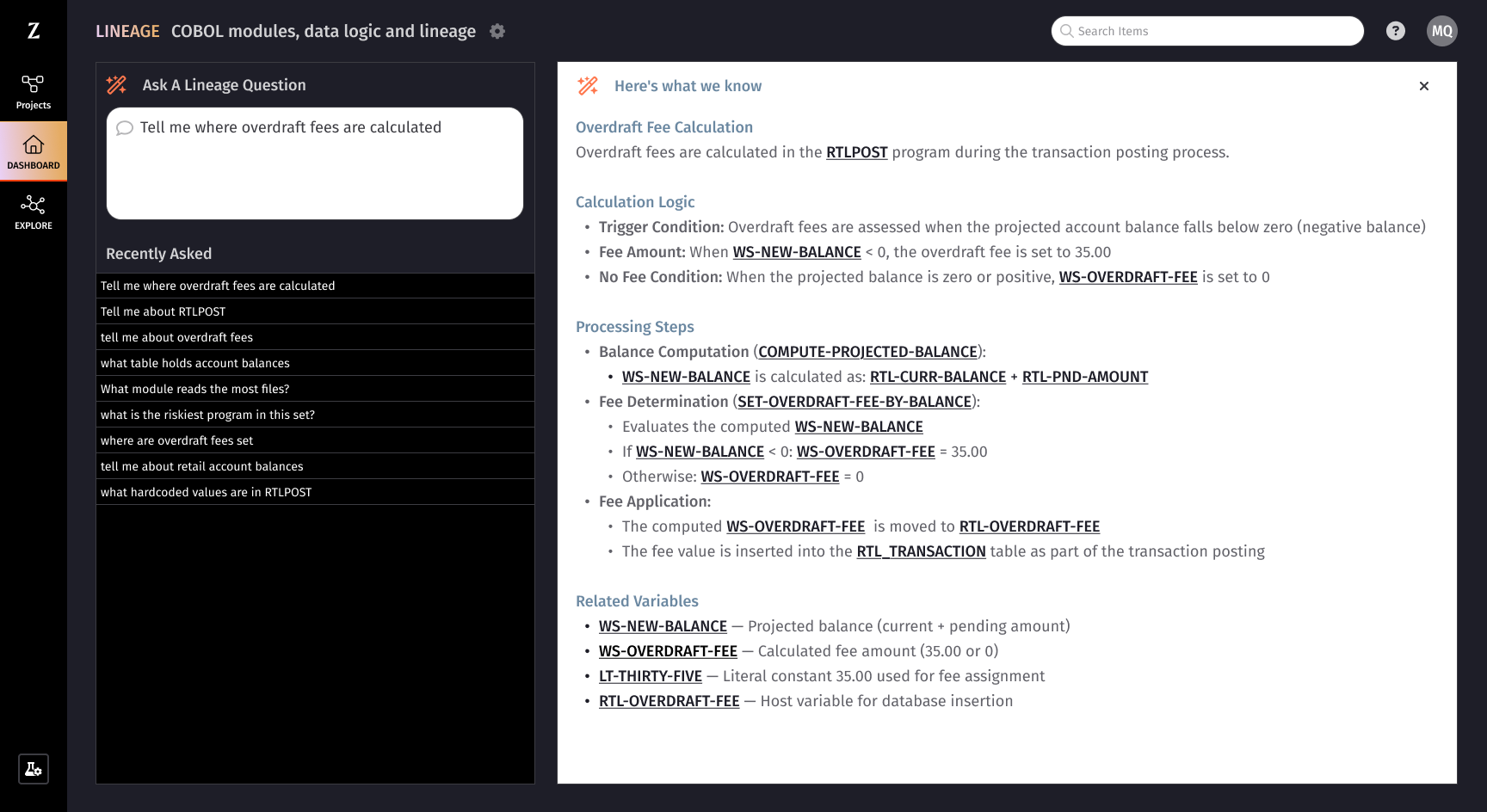
Ask in plain English where a value comes from, and get the calculations, business rules, and branches behind it — not just where a number flowed, but how it was calculated.
Your legacy systems, decoded — in business-friendly language
Explore every module, table, and field — and read the calculations and logic behind them, traced across your codebase and explained in plain English.
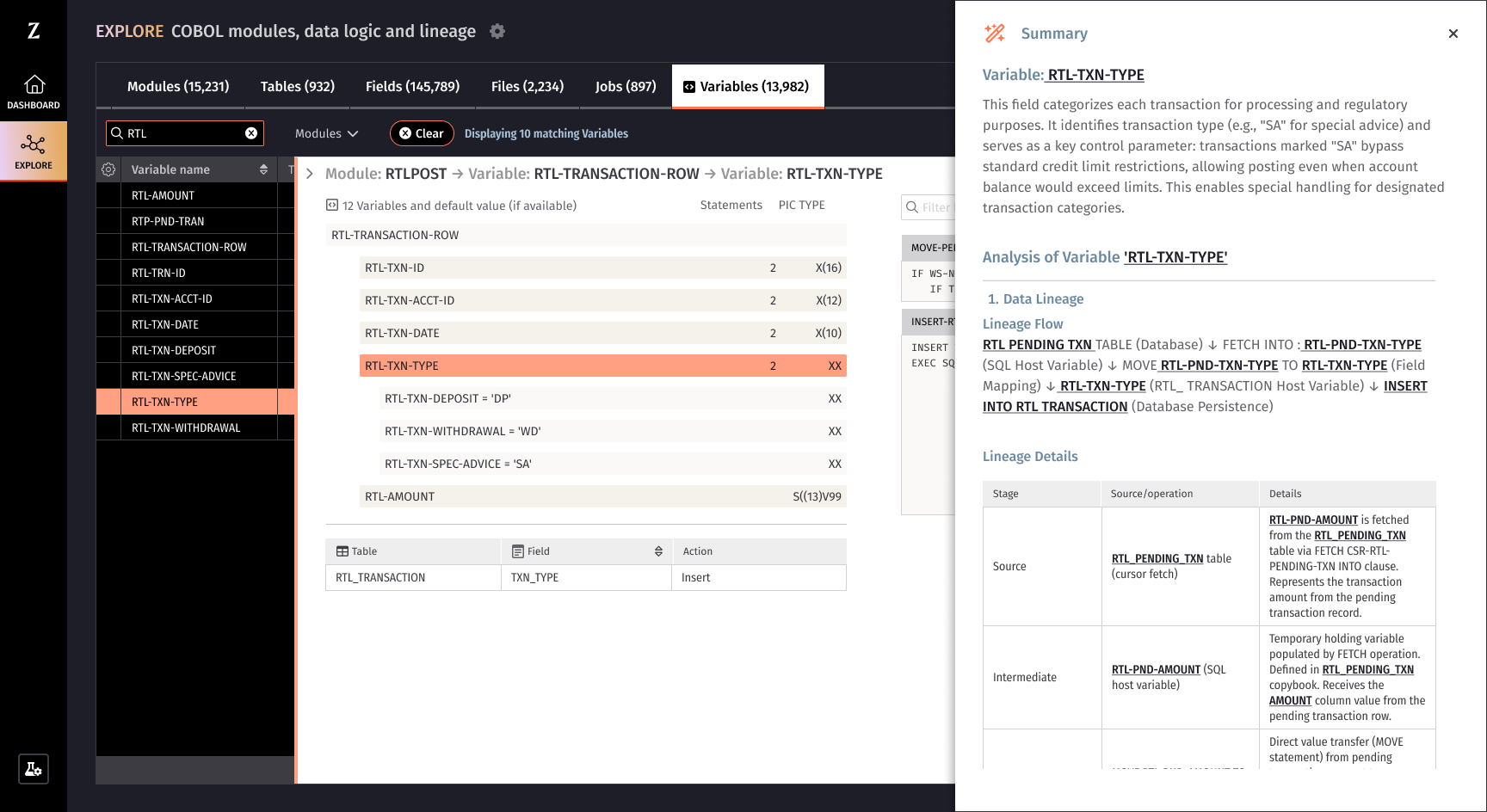
Every module, table, and field — with call-frequency and complexity.
A full data dictionary with context and origin tracing.
Business rules and branching, extracted and explained in plain English.
Pinpoint what feeds regulatory reports — and what breaks if it changes.
COBOL, RPG, and PL/1 are the code languages that built the applications running inside Mainframe and AS/400.

A defensible path to compliance — from a system with no documentation
At a Fortune 100 bank, Zengines produced a Critical Data Elements report for a core system that had no prior documentation or lineage — turning months of manual analysis into minutes and giving the bank a defensible path to compliance while de-risking its mainframe modernization.
Read the case study ↗Built for the leaders who own legacy & enterprise data
Meet data-governance and lineage requirements with explainable lineage for every critical data element.
Understand legacy systems deeply enough to plan and de-risk modernization.
Satisfy BCBS-239, ORSA, and Solvency II with defensible Critical Data Elements.
Document and manage legacy systems day-to-day — without depending on the last COBOL expert.
Where contextual lineage earns its keep
Regulatory & audit compliance
Prove Critical Data Elements and the logic behind them — BCBS-239, ORSA, Solvency II — in minutes, not months.
“Excellent use of AI to analyze age-old legacy applications — extracting meaningful outputs that would otherwise be very cumbersome. It eliminates the need to review thousands of lines of legacy code and provides data-lineage reports and critical-data-element identification.”
Frequently asked questions
What is data lineage?+
Data lineage traces where data comes from and how it moves across systems. Contextual data lineage goes further — reading the calculations, conditions, and business rules in the code to explain how and why a value is produced.
What is contextual data lineage?+
It’s Zengines’ approach that reads the logic inside legacy code — COBOL, RPG, PL/1 — and follows a data element across every program that touches it, making legacy data explainable and defensible rather than just visible.
Why is data lineage important?+
It lets analysts defend a number, regulators trust the inputs (BCBS-239, ORSA, Solvency II), and AI models use data that can be explained — and it de-risks modernization by revealing what depends on what.
How do you track data lineage for AI-model compliance?+
Zengines identifies Critical Data Elements and documents their logic and dependencies, giving a defensible record of exactly what feeds a model — and what would break if it changed.
Make your data explainable — and defensible
See how Contextual Data Lineage reads the logic inside your systems, so analysts, regulators, and AI models can all trust the answer.