

About the client
The client is a Fortune 100 financial services institution running a portion of its transaction core on IBM iSeries (AS/400) platforms written in RPG. This application originates and processes core banking transactions and serves as the intake point for external transactional data: high-volume, always-on, and central to the firm’s operations. It feeds accounting, ledger, and most of the downstream systems across the enterprise.
The challenge
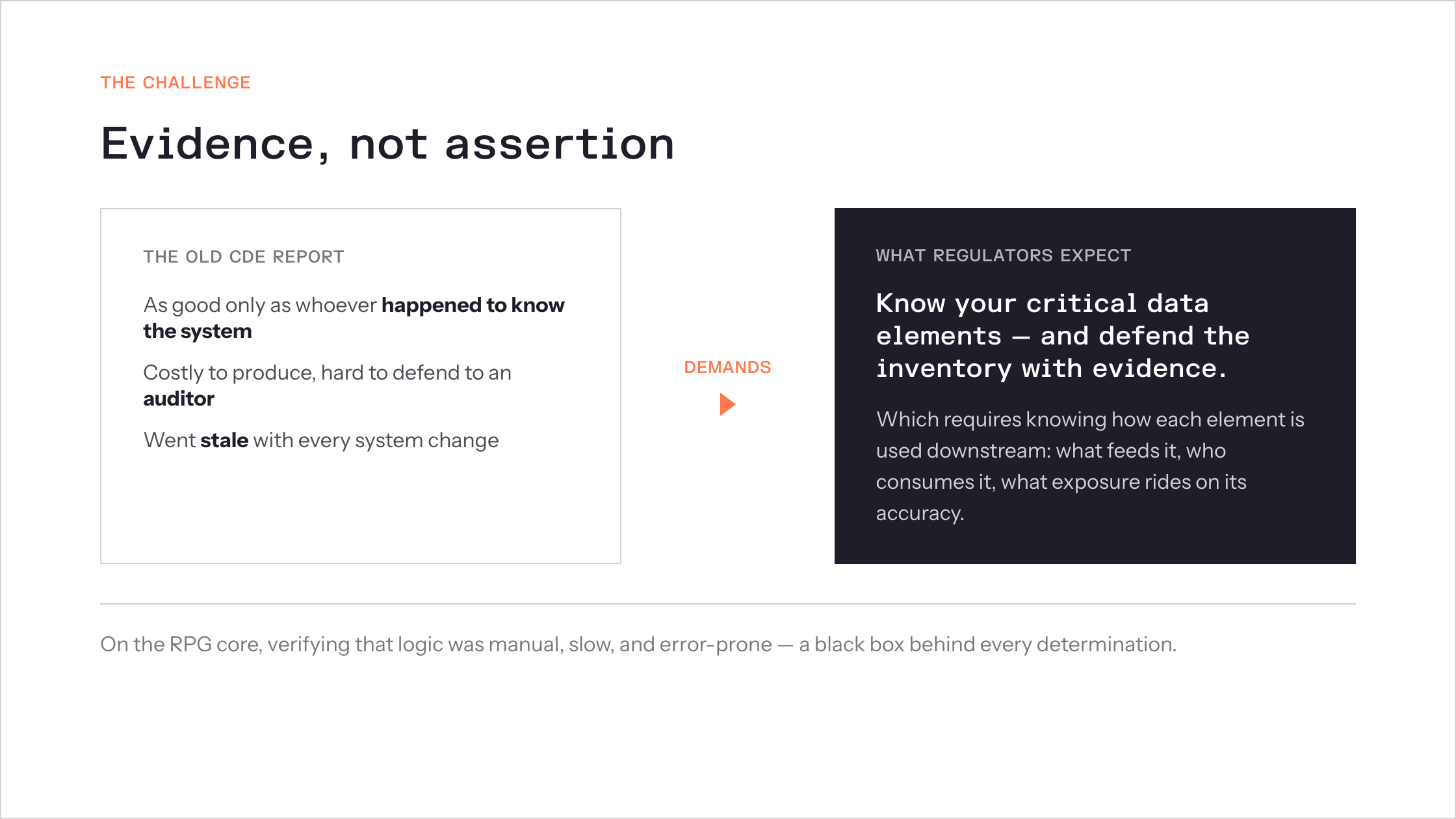
Regulators expect financial institutions to know their critical data elements and to defend that inventory with evidence, not assertion. Determining whether a data element is critical requires knowing how it is used downstream: what it feeds, who consumes it, and what regulatory exposure or financial impact rides on its accuracy.
On this transaction core, verifying that against decades-old RPG logic was manual, slow, and error-prone – a black box that made every determination harder to reach and harder to defend. Every system change also put the catalog at risk of going stale, with no efficient way to refresh it. The result was a CDE report that was costly to produce, difficult to stand behind in front of an auditor, and hard to keep current.
Our critical data elements list was only ever as good as the people who happened to know the system. That is a hard thing to put in front of an auditor, and a harder thing to keep current.
— Risk & Compliance Lead, Fortune 100 financial services institution
The solution: Contextual Data Lineage
The customer’s Data and Application Owner team used Zengines Contextual Data Lineage to meet CDE compliance – and to deliver AI-ready data to an AI agent.
A CDE catalog, built from code, lineage, and context
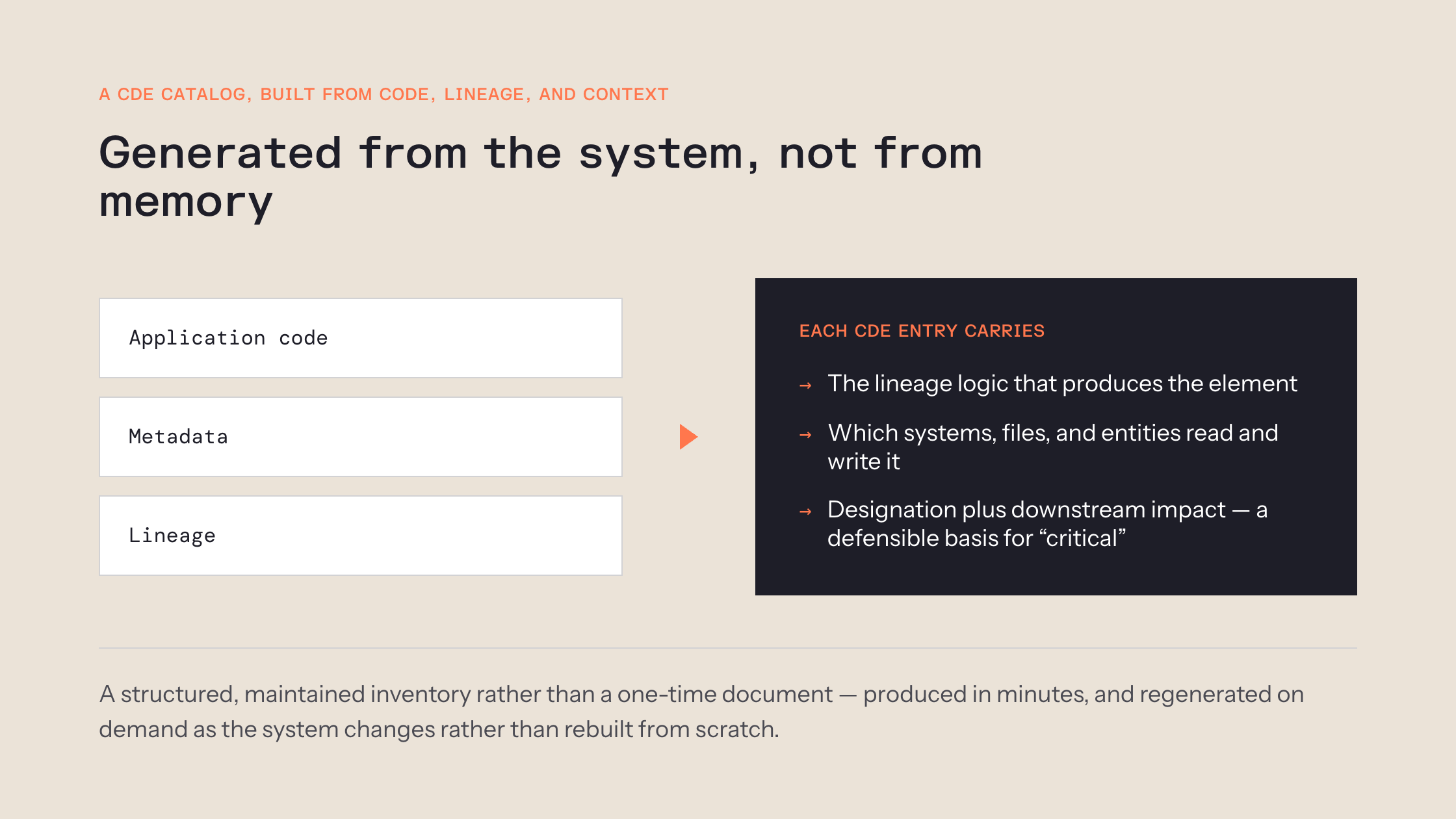
Zengines generated the baseline CDE catalog directly from the application’s code, metadata, and lineage, doing the heavy lifting that had previously fallen to manual review: a structured, maintained inventory rather than a one-time document. Each entry carries the lineage logic that produces the element and the downstream implications of that element, including which systems, files, and entities read it and write to it.
That combination – designation plus downstream impact – gives the team a defensible basis for calling an element critical, and for stating exactly what changes and to whom when something upstream shifts. Work that had previously taken months of manual gathering was now produced in minutes, and can be regenerated on demand as the system changes rather than rebuilt from scratch.
Extending into data quality on critical data elements
The team expanded the same metadata- and lineage-based approach to cover more compliance requirements: data quality on each critical data element in the catalog. Every CDE was assessed against applicable data quality dimensions, inclusive of the bank’s own data quality policies, to identify and profile the data quality coverage available for that element – extending the same objective, automated approach further into compliance.
AI-ready data for a compliance AI agent
This CDE catalog was traceable to source, mapped to downstream impact, and checked for data quality: defensible, explainable, and contextual. That same foundation made it AI-ready. The team fed it directly into a compliance AI agent, giving the agent data it could act on rather than data still waiting to be verified.
The results
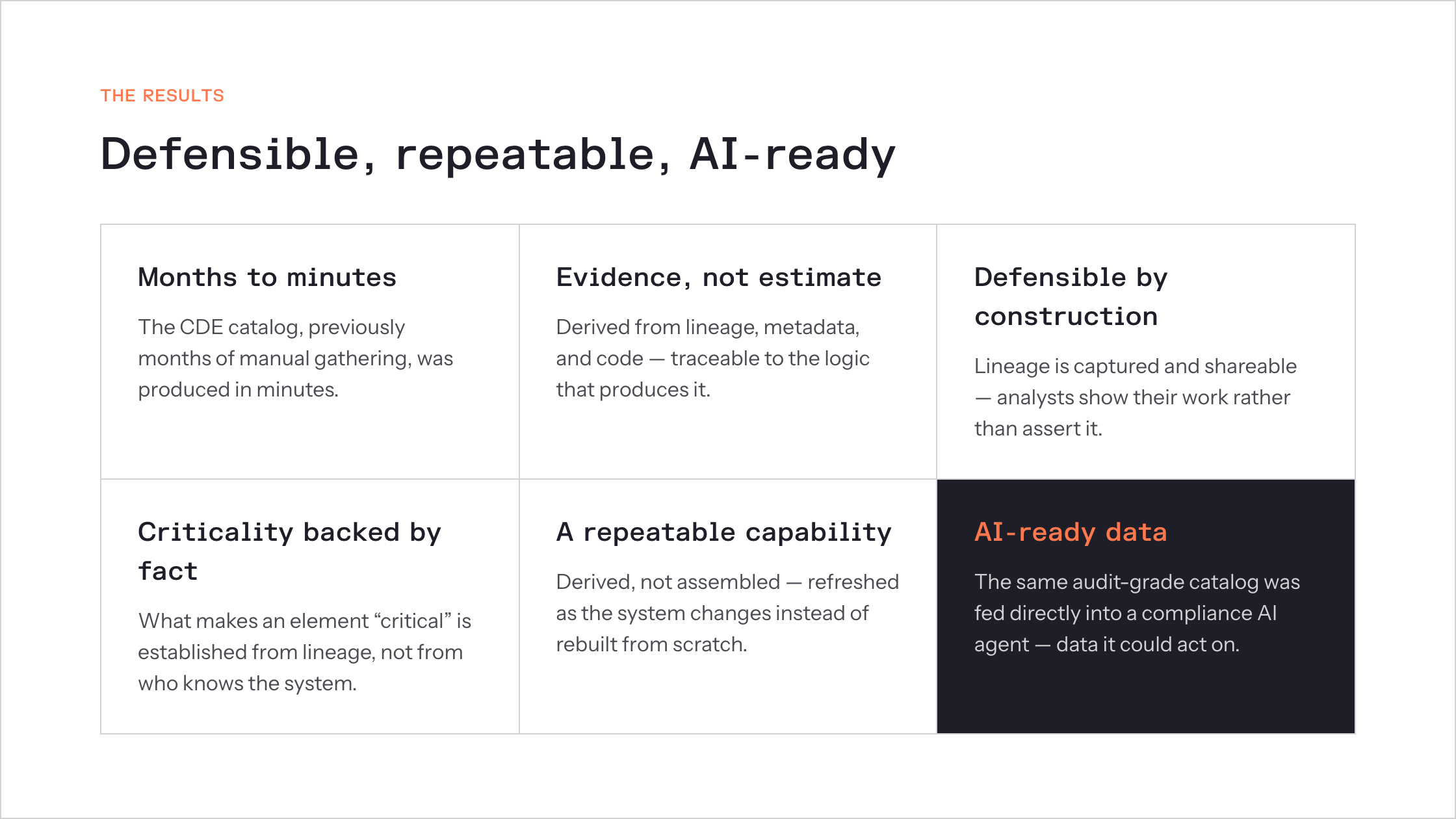
- Months to minutes. The CDE catalog, previously months of manual gathering, was produced in minutes.
- Evidence instead of estimate. The catalog is derived from lineage, metadata, and code rather than human recollection. It is the difference between a CDE inventory resting on someone’s memory and one that can be traced back to the logic that produces it.
- Defensible by construction. Lineage is captured and shareable, so the analysts responsible for audit response can show their work rather than assert it.
- Criticality backed by fact. What makes an element “critical” – who and what uses or depends on it – is established from lineage rather than gathered or volunteered from whoever happens to know the system.
- A repeatable capability. Because the catalog is derived rather than assembled, it can be refreshed as the system changes instead of rebuilt from scratch.
- AI-ready data. The same catalog that stands up to audit scrutiny was fed directly into a compliance AI agent, giving it traceable, explainable data to act on rather than data that still needed to be verified first.
Extending the same lineage into data quality profiling gave the risk and regulatory function an objective basis for trust in the data – assessed against both applicable quality dimensions and the bank’s own policy – rather than a periodic manual attestation.
This CDE catalog was built to hold up under the scrutiny compliance demands: traceable, defensible, evidence-backed. That same bar is exactly what makes it usable for something bigger. Every company wants AI agents working on their data right now, and almost none of them can say their data meets that bar. This is what it looks like when it does.
— Caitlyn Truong, CEO, Zengines
Learn more about Zengines
Zengines makes financial services data trusted and explainable, through the Turnkey Data Migration Platform and Contextual Data Lineage. See what it surfaces inside your legacy code.