

I attended two separate events in Chicago this fall: Snowflake World Tour on October 5 and the Databricks Data + AI World Tour on October 29. I went to compare what each company was saying about data and AI, and how well that matched what the businesses we work with are grappling with today. Each event had its own emphasis, and both kept returning to the same idea, which is that AI agents depend on enterprise context and each platform is building the layer that holds it.
That direction matches what we heard from banks and market infrastructures at Sibos in Miami a few weeks earlier. It also sharpens a question many financial institutions have not yet answered, which is where their own business context lives today and whether these new context layers will be able to see it.
Snowflake focused on bringing data and its meaning into the platform
Snowflake CEO Sridhar Ramaswamy opened the Chicago event with a keynote titled “Powering the Era of the Agentic Enterprise.” He named fragmented enterprise architecture as one of the main limits on AI and returned to a line Snowflake has used for some time: there is no AI strategy without a data strategy. The picture he drew placed AI models on top of an agentic plane, which draws on enterprise data and context on one side and applications on the other. That framing builds on the Open Semantic Interchange initiative Snowflake launched in 2025 with Salesforce, dbt Labs and other partners (now the Apache Ossie project, which Databricks also backs), which described fragmented data semantics across tools and platforms as a major roadblock for AI.
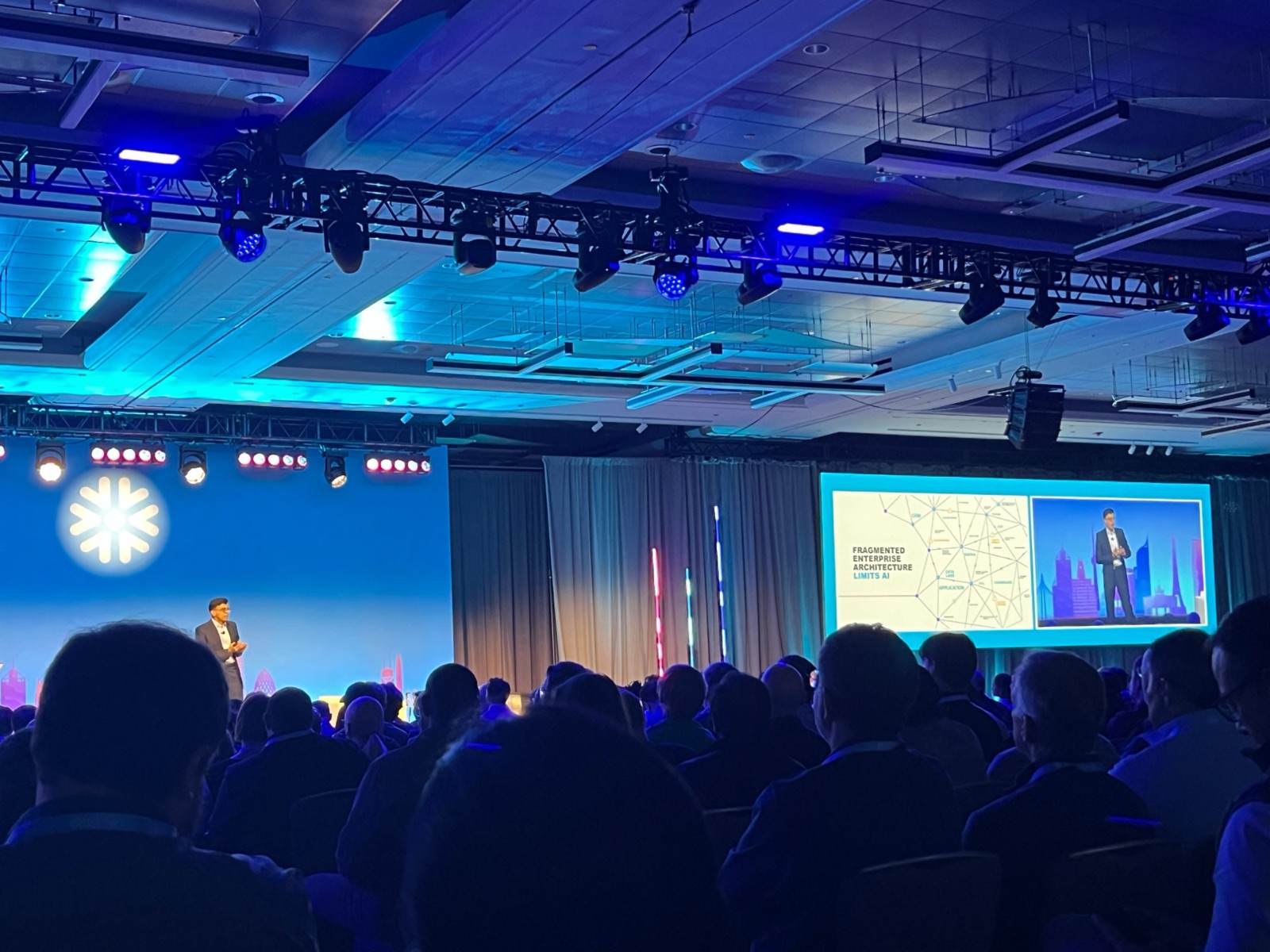
From there, much of the event centered on getting data and its definitions into one place in a usable form. Snowflake described separate layers for semantics, governance and the data itself, and its Semantic View Autopilot now automates the creation and governance of semantic views so that agents work from consistent business definitions. Snowflake also showed governance policies written in natural language and connected to CI/CD pipelines, along with Cortex AI Gateway.
Snowflake treated migration as a foundation
The same focus on getting data into the platform shaped how Snowflake talked about migration, which it presented as part of the AI story rather than a separate infrastructure project. Snowflake’s own writing on enterprise migration describes large-scale migration as one of the most complex and risky initiatives an enterprise undertakes, because teams have to assess thousands of objects, modernize legacy code, migrate critical data and validate the outcomes while keeping the business running. It identifies validation as one of the most critical and resource-intensive phases, and summarizes the point simply: “Data migration success depends on trust.”
What I took from this is that AI is making migration faster, and speed is only part of what a migration has to deliver. The context matters as much as the conversion: the business logic inside the source code, the decisions made along the way, and the knowledge that explains why a field holds what it holds. Snowflake positions its migration agent as a replacement for the spreadsheets, manual tracking and institutional knowledge that many migrations still run on. When that context stays in spreadsheets or in people’s heads, the data reaches the new platform without the explanation agents need, and organizations that run migration as a repeatable program meet that gap again with every system they move.
This reflects what we see in financial services, where a migration that moves data quickly but cannot prove it arrived correctly creates more work than it saves. Validating early, carrying the business logic forward and reconciling after the move is what lets a migration produce data that people are willing to rely on.
Databricks focused on managing and governing context
Where the Snowflake event centered on bringing data and meaning into the platform, the Databricks event centered on what happens to that context once it is there. David Meyer, SVP of Product Management, built his keynote around one line, that AI does not have an intelligence problem but a context problem. He then described the Databricks stack with enterprise context at the top, unified governance through Unity Catalog and the Unity AI Gateway, agentic data services spanning Lakeflow, the lakehouse and Lakebase, and open formats such as Delta and Iceberg keeping the design portable across clouds, models and data. The line carries forward the message Databricks CEO Ali Ghodsi gave at Data + AI Summit in June, which BigDATAwire summarized in nearly the same words.
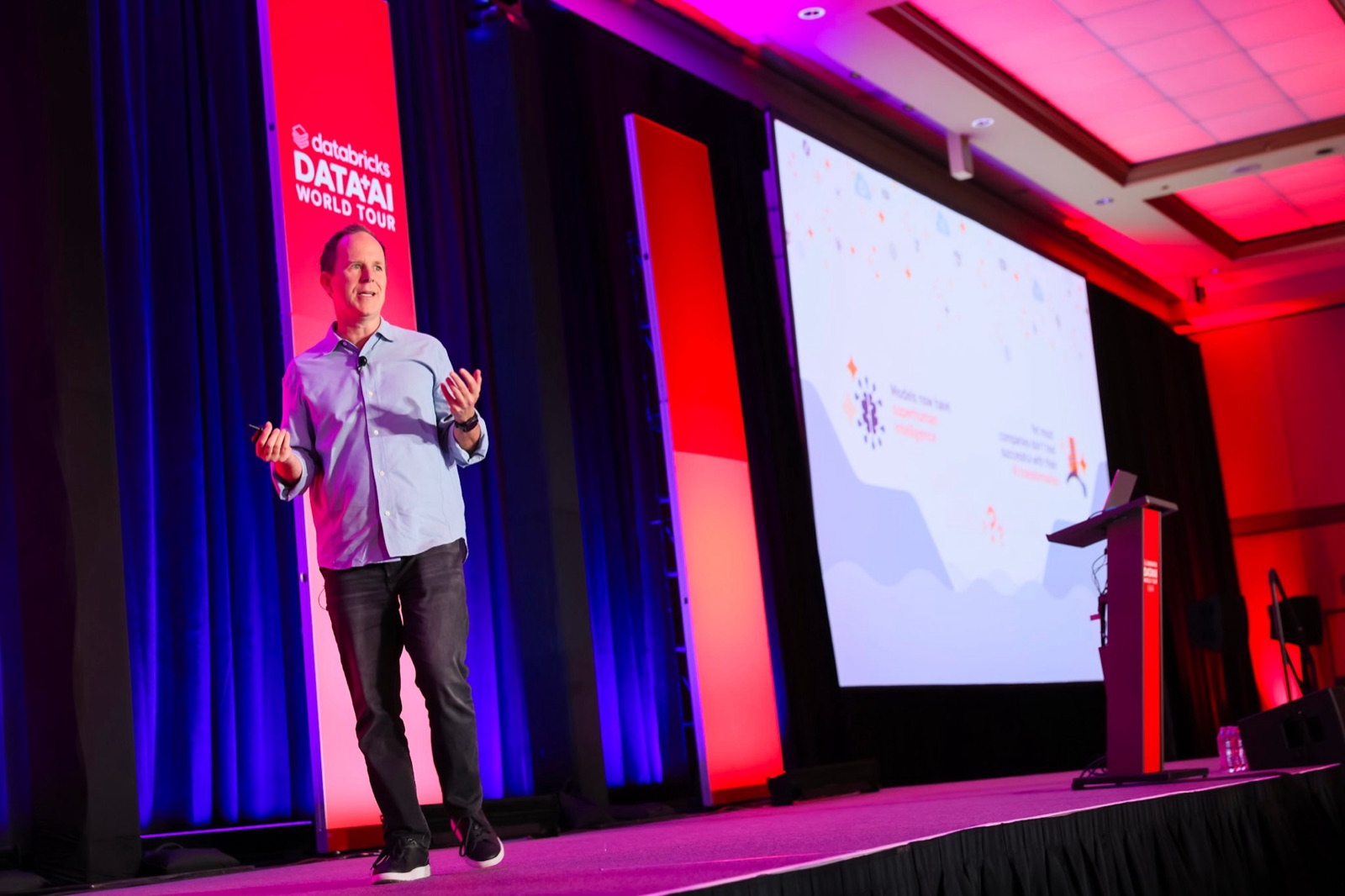
The centerpiece of that context story is Genie Ontology, which Databricks describes as a live context layer that continuously learns the business from data, documents, tags, content, apps and people. One session showed an order of operations that fits regulated data well, with a data quality agent connected through MCP checking the data first and only then a business user asking Genie a question.
Databricks governs code, people and agents under one control plane
Governance was the other half of the Databricks context story, which Databricks described as spanning code, people and agents under one control plane, with models, MCP servers, skills and agents managed through the Unity AI Gateway and routing and spend controls in the same place.
For a regulated institution, this is where the platform and the compliance team meet. An agent that acts on a capital, risk or client figure has to be able to show where that figure came from and what logic produced it, because explainability is what makes data AI-ready in a regulated environment. While a single control plane makes that easier to enforce, it still needs lineage and provenance underneath it that reach all the way back to the system where each value was created.
Both events treated captured context as the foundation for agents
Despite their different emphases, the two events met on one point: agents are only as useful as the context they can draw on. Genie Ontology and Snowflake's semantic views both learn from what an organization has already captured, such as BI definitions, queries, dashboards, documentation and tags. That is a strong starting point, and it also means the quality of an agent's context depends on how much of the business has been written down somewhere these tools can read, which is the same gap we explored in the difference between data access and data lineage.
In financial services, much of the context has never been written down
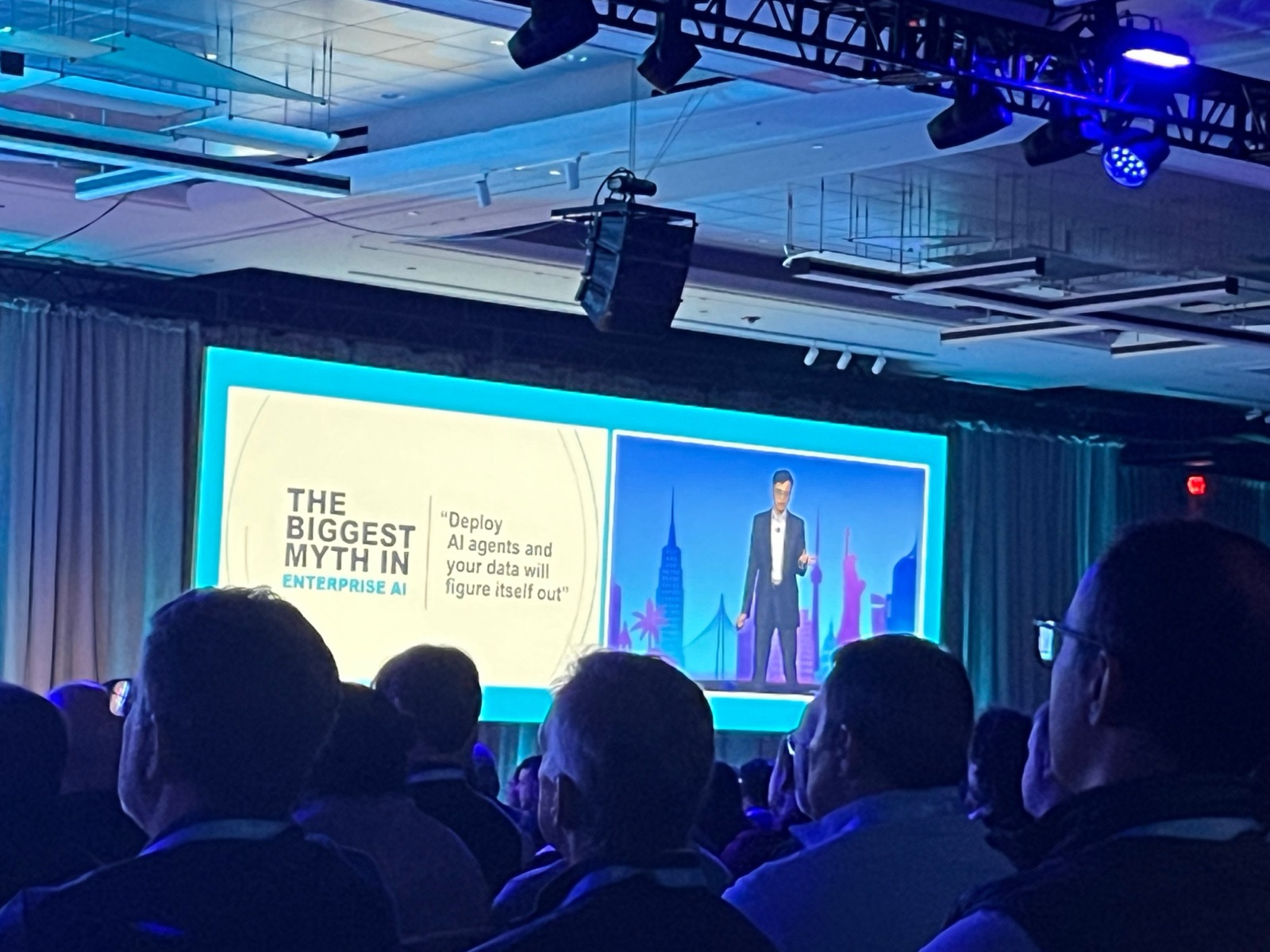
One slide from the Snowflake keynote named what it called the biggest myth in enterprise AI, the belief that you can “deploy AI agents and your data will figure itself out.” Both platforms are building strong places for context to live and be managed – but in most financial institutions, a large share of the context that matters most has not yet arrived there. The calculation behind an effective interest rate, the exception that applies to one product line, and the batch sequence that determines when a balance is final are often recorded only in COBOL programs and job schedules. Ontologies and semantic views cannot infer that logic from dashboards or queries, because it was never expressed there, which is why knowledge and logic extraction has become a prerequisite for this kind of context in banking and insurance.
Institutions have two paths for that legacy estate, and both lead to the same need. Some will retire their mainframes gradually, and many will keep them running and modernize in place, sending data into Databricks or Snowflake while the system of record stays where it is. In either case, the context has to be extracted from the code and carried into the platform alongside the data.
How Zengines helps
Zengines brings the data a financial institution depends on, together with its context, into platforms like Databricks and Snowflake. Contextual Data Lineage reads COBOL, PL/1, RPG and JCL, discovers and extracts the logic, calculations, rules and exceptions inside them, and explains them in plain English, tracing each field back to the program and job step that produced it. That context can then land in the platform's catalog, such as Unity Catalog, as a persistent context layer that semantic views, ontologies and agents can draw on. The Turnkey Data Migration Platform validates and reconciles data as it moves, and its Logic Discovery feature flags business logic and exceptions along the way, so the data arrives trusted. Together, the two products make legacy data trusted and explainable, which keeps AI readiness an ongoing state rather than a one-time achievement.
My takeaway
Seeing the two events a few weeks apart, the difference I noticed was one of emphasis. At Snowflake, the conversation centered on getting data and its meaning into the platform through semantics, interoperability and migration, and at Databricks it centered on managing and governing that context once it is there. Both lead to the same place, where agents act on enterprise data and context determines how much value they deliver.
The context journey: what Databricks and Snowflake offer
| General-purpose capabilities the platforms offer | Databricks | Snowflake | What it takes to make it truly useful |
|---|---|---|---|
| Ontology and context layer that defines what business concepts mean |
|
|
|
| Semantic layer that defines business terms and how key figures are calculated from the underlying data |
|
|
|
| Catalog that holds context and governs access to data and AI |
|
|
|
| Migration tools used to build and run the move of data onto the platform |
|
|
|
| Open table formats that let different engines share one copy of the data |
|
|
|
| Open semantic standards that let definitions move between tools |
|
|
|
| AI gateway that governs which models, agents and MCP servers (the tools and data sources agents connect to) are used |
|
|
|
Products are grouped by purpose and are not one-to-one equivalents; features and availability differ, and several are in preview, so check each platform’s current documentation.
As the table above shows, both platforms offer capabilities along that context journey, from ontologies and semantic layers to catalogs, migration tools and AI gateways. These are general-purpose capabilities, and the value an institution gets from them depends on what it brings: the business rules and calculations specific to its operations, the domain expertise to confirm that data and definitions are right, and the technical expertise to move data and its context onto the platform. In financial services, much of that work sits in capturing context from legacy systems and in migration itself. The opportunity is to make sure the context in an institution’s oldest and most important systems reaches these platforms too, which builds on the same idea behind our view of AI-ready data in financial services.
If your team is bringing legacy data into Databricks or Snowflake, see what AI-ready data looks like with Zengines →
Frequently asked questions
What did Snowflake and Databricks focus on at their 2026 World Tour events?
The two companies held separate World Tour events, and both centered on AI agents and the enterprise context they need to work reliably. Databricks emphasized context management and governance through Genie Ontology, Unity Catalog and the Unity AI Gateway, while Snowflake emphasized semantics, interoperability and migration as a foundation for AI readiness.
What is a semantic layer?
A semantic layer defines business terms, metrics and relationships on top of raw data, so that people and AI tools interpret the data the same way. Databricks implements this with Unity Catalog Metric Views, and Snowflake with Semantic Views.
How should financial institutions prepare legacy data for Databricks or Snowflake?
Start by validating the data before it moves and reconciling it after it lands, so the platform receives data the business can rely on. Then extract the business logic from legacy code such as COBOL and JCL and carry it into the platform's catalog, so the context travels with the data and agents can explain their results.